Thanks to Our Partners and sponsors
The project has been made possible with the support of a number of funds and institutions, to whom we would like to extend our sincere thanks.
Their contributions have been essential in enabling us to carry out research on gut preparation, stage an exhibition where artistic expression meets intangible cultural heritage, and share knowledge with the wider community.
We would like to thank the following funds and partners for their support:
February 1, 2026 – Puggut Talk
In connection with the special exhibition, the exhibitors each shared their approaches to working with gut skins—from craft, artistic, and historical perspectives.
Puggut Anernerat - Breathing Membranes
Project Breathing membranes - Gutskins Tradition and Innovation
(KAL: Puggut anernerat - Inalukkereriaatsit nutaaliornerlu)
Seamstress Sofie Amondsen (Kalaallit Nunaat), textile artist Julie Bach (Denmark), and the Greenland National Museum (Kalaallit Nunaat) collaborated on a project that explores gut skins as an artistic and cultural material.
The aim was to develop a shared understanding of the traditional methods for processing animal intestines—a practice that is gradually disappearing in Kalaallit society. The project emphasized that such an effort is crucial to safeguard the significance, methods, and techniques of gut preparation. It not only sought to expand knowledge through experimental activities, where participants tested techniques themselves, but also fostered collaboration among cultural actors and contributed to preserving and sharing valuable traditions.
Gut skins as a material have the potential to be lightweight, breathable, and waterproof. This knowledge was further applied in the design of works created by Julie Bach and Sofie Amondsen for the special exhibition held from October 3, 2025, to February 22, 2026, at the museum. The exhibition aimed to show how ethnographic objects can inspire the creation of crafts and artistic expressions using this material. In other words, the project built a bridge between traditional sewn gut craftsmanship and contemporary interpretations.
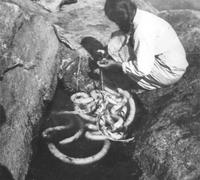
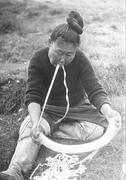
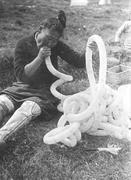
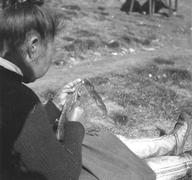
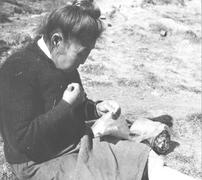
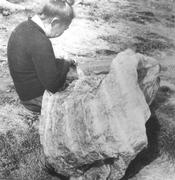
Through ethnographic objects and documentation, we know that gut preparation has been practiced among the Inuit in Kalaallit Nunaat to produce functional items, clothing, windows for turf houses, skins for tent curtains, and hides for traditional drums. Some of these objects are held in museums and are studied to gain an understanding of sewing techniques.
Today, guts are primarily used as a delicacy, often as an integral part of traditional dishes and festive meals. One of the most common ways to prepare seal intestines is by boiling them. When boiled, they become soft and tender and can be served alone or together with fat or meat. Dried intestines are also eaten, providing a more concentrated flavor. Although many still enjoy them, their popularity in certain local communities may have changed over time due to shifts in diet and the availability of other foods. Nevertheless, they remain an important part of cultural heritage for many communities, and their use and preparation continue to be passed down through generations.
The project therefore extends toward the craft and textile-artistic potentials of gut, offering a perspective on how it can once again be used in the community—not least by providing creative opportunities and inspiring renewed interest.
The project culminated in:
Knowledge-Sharing Workshop
February 18, 2025 - February 28, 2025
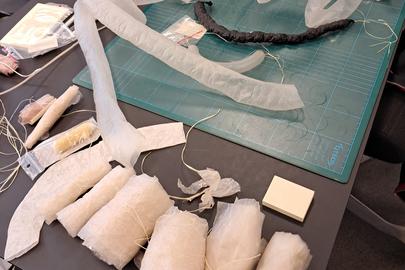
The project delved into traditional gut preparation to develop knowledge about cleaning, drying, cutting, and stitching for waterproof seams, with a focus on quality and durability. Learning took place through an experimental approach, where different methods were tested.
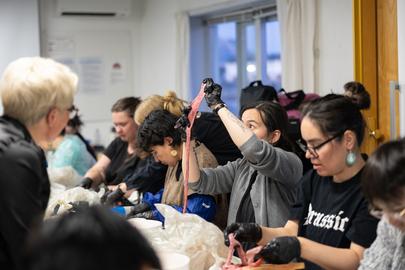
In close collaboration between all project partners and the local sewing workshop in Nuuk, Kittat, a workshop was held where participants shared their own expertise and exchanged knowledge about gut preparation and practical techniques in the processes of creating gut skins.
The knowledge gained during the workshop has been compiled into an instructional video, which you can find on the side.
Booklet
Online
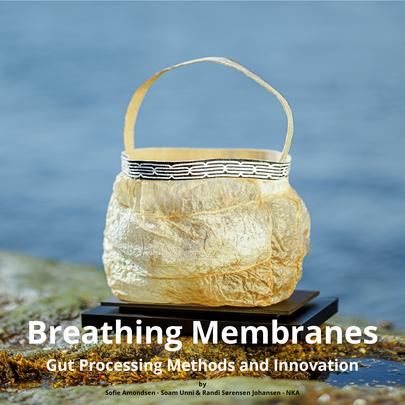
The project produced a booklet, available online for everyone, describing methods for gut preparation and innovation. The booklet is presented in an easy-to-read format and outlines a step-by-step process for creating gut skins for craftwork, with a focus on quality and durability.
The knowledge gained during the project has been compiled in the booklet, which can be used by anyone interested in trying out the techniques and understanding the details of gut preparation as well as the craft possibilities.
The booklet is available in both Greenlandic and English.
Special Exhibition
Oktober 3, 2025 - February 22, 2026
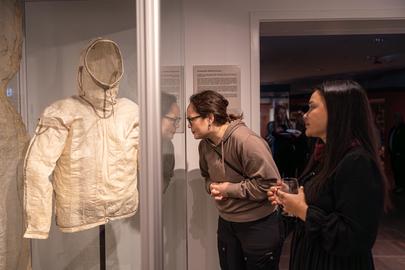
The autumn exhibition crossed disciplines, bringing together art, craft, and history.
Julie Bach’s work with healing through sewing added a sensory dimension, encouraging visitors to connect with their emotions and their bodies.
Sofie Amondsen presented a contemporary interpretation of traditional techniques, focusing on everyday objects in the home and creating a bridge between past and present.
The museum contributed historical perspectives through stories, research, and displayed objects that highlighted the cultural significance of seal intestines.
Community Workshop
September 29, 2025 - Oktober 2, 2025
The project hosted a Puggut Workshop in Nuuk. This citizen-focused workshop gave participants the opportunity to learn about processing, drying, and sewing gut skins.
Inspired by historical techniques, participants created their own gut skin artworks, which were both creative and skillfully crafted.
The finished pieces were subsequently exhibited at Cultural Center Katuaq for a week, allowing the public to experience the participants’ work and gain insight into the techniques and processes behind gut skin production.
The workshop gathered knowledge and experience that can inspire others to experiment with gut skins as a material—combining both tradition and creative expression, something that is already visible and felt in the community today.